EMT Practice Test

1. Question Content...


Question List

Question1: The values of two different variables are related to each other such that an increase in the value of the first variable is accompanied by a decrease in the value of the second variable. If the variables are perfectly correlated, their correlation coefficient will be equal to

Question2: Which of the following tools should be used to break a broad goal into increasingly detailed levels?

Question3: Given a sample mean. X = 515. a sample standard deviation, s = 9. and a sample size, n = 6. what is the absolute value of the Student's t statistic to test if the sample mean is equal to the population mean, U = 500?

Question4: Which of the following elements is essential for a run chart?

Question5: Which of the following types of planning uses a strategic planning process that relates idealistic goals to work strategy?

Question6: A leak test is performed on every water tank. The production superintendent wants to know the location of each leak on defective tanks. Which of the following tools is most appropriate for collecting this data?

Question7: Risk control includes making decisions using which of the following pieces of information?

Question8: Short-run SPC should be used in which of the following situations?

Question9: Which of the following activities is a form of error-proofing?

Question10: Failure to cite the significant contributions of other individuals in a final manuscript for publication violates which category of the ASQ Code of Ethics?

Question11: Which of the following statements is true about control charts?
Calculator

Question12: The following summary of data represents the amount of time customers spend in a store between the hours of noon and 1:00 p.m. during a one-month period.
Time (minutes)Number of customers
1030
925
815
76
64
535
432
315
242
1 or less50
The summary is an example of which of the following?

Question13: Which of the following tools can be used to communicate performance data in time sequence?

Question14: In a sample of 2.000 items taken from a large lot. 80 are found to be nonconforming. What is the 95% confidence interval for the proportion of nonconforming items?

Question15: For a normal distribution, what is the value of k when li±£g contains 75% of the observations?

Question16: If a quality engineer discovers a situation in which unlabeled finished product could be shipped to customers, what would be an appropriate preventive action to take?

Question17: Failure mode, effect, and criticality analysis, (FMECA) is primarily for the purpose of

Question18: Which of the following equations is used to calculate the upper control limit for an average chart?

Question19: If the probability of two cars starting on a cold morning is 0.6 for each car. what is the probability of at least one of the cars starting?

Question20: Which of the following factors has the most influence on the success of quality initiatives?

Question21: Writing and establishing process control procedures is

Question22: Which of the following tools can be used to determine the best option from many choices based on their importance and merits?

Question23: A customer rates its suppliers for which of the following reasons?

Question24: If a value assigned to a unit is non-numerical. it is described as
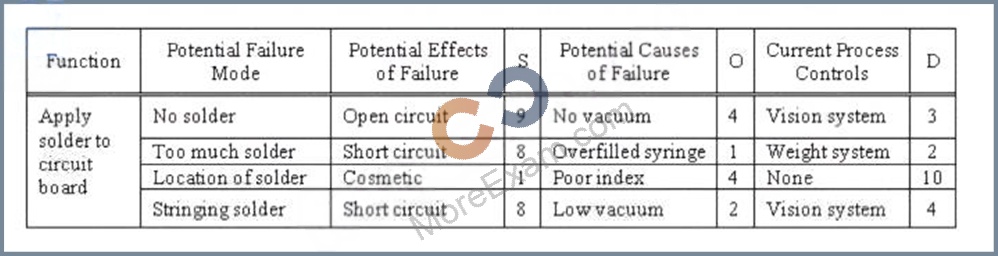
Question25: Refer to the following FMEA table. The columns labeled S. O. and D. refer to ratings of severity, occurrence, and detection, respectively.

Which potential failure mode is most likely to be seen by a customer?

Question26: Which of the following definitions describes severity?

Question27: A test-retest study is performed to a coordinate measuring machine (CMM) using a working standard of
100.00 ± 0.001 mm (95% confidence). The length of the standard is measured 30 rimes. The mean and standard deviation of the measurements are x = 107.883 mm and 5 = 2.497 mm. All of the measurements are made are the same location on the standard and are taken by the same technician, who mounts and dismounts the unit for each measurement.
The precision of the CMM is estimated to be

Question28: A material review board (MRB) gets its authority to act from which of the following functions?

Question29: Registration to the ISO 9001 standard requires which of the following types of audit?

Question30: Which of the following symbols represents process performance index?

Question31: A production line has job aids that outline, step by step, how to perform the tasks of the job. This is followed by each of the operators working on the line. This is an example of

Question32: Which of the following statements is true about the average outgoing quality limit (AOQL)?

Question33: Which of the following actions best describes quality function deployment (QFD)?

Question34: Which of the following test methods is considered destructive?

Question35: Which of the following elements describes the combination of the severity and probability of occurrence of harm?

Question36: A company uses four components (W. X. Y. and Z) to create its final product. The source and time factors for these components are listed below. What is die critical path for this company's final product?
ComponentSourceAcquisition TimeInstallation TimePredecessor Steps
WInternaln/a4 weeksNone
XExternal5 weeks4 weeksNone
YInternaln/a4 weeksW.X.Z
ZInternaln/a6 weeksNone

Question37: Which of the following information should be contained in work instructions?

Question38: Which of the following symbols indicates a termination point on a flowchart?
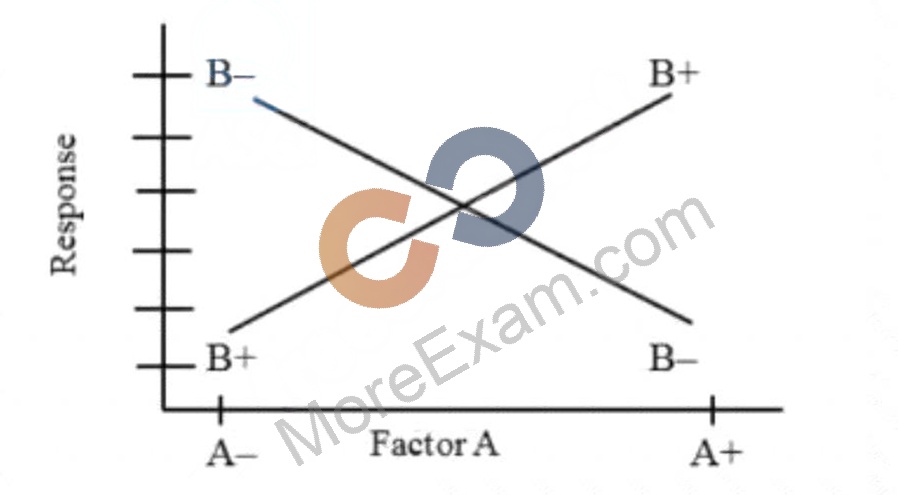
Question39: The following diagram was developed from a designed experiment.

Which of the following statements is true about the factors in this experiment?

Question40: Temperature measured in degrees centigrade is an example of what type of measurement scale?

Question41: The primary benefit of implementing a supplier rating system for an organization is to

Question42: Which of the following statements is always true about an effective design review?

Question43:
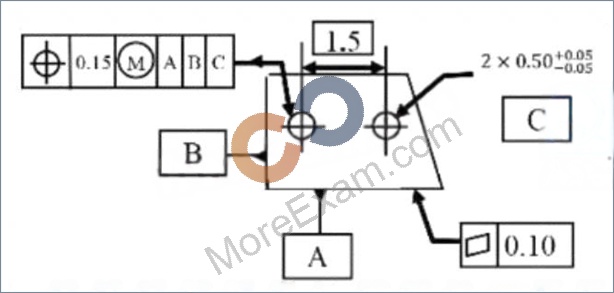
M in tills drawing, the symbol is being used to indicate the
H Calculator
Question44: The design function which assigns probability of failures between components or subsystems is called

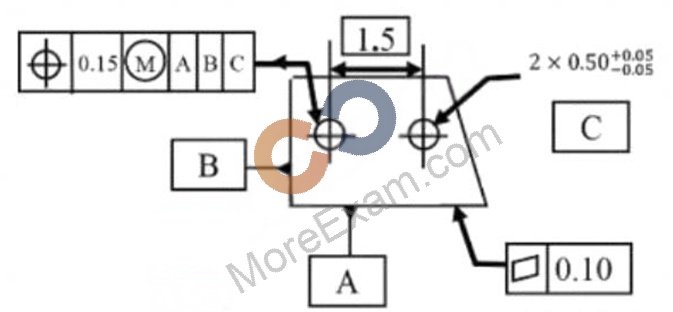
Question45: The holes in this drawing have what kind of tolerance?

The holes in this drawing have what kind of tolerance?

Question46: A cause and effect diagram is also called which of the following?

Question47: When a 24 experiment is fractionated to a 24'5 experiment, the fractioned design is also known as a

Question48: Competition, safety, warranty, service costs, and public liability are all characteristics of

Question49: A failure node and effects analysis (FMEA) should be classified in what cost of quality category?

Question50: The probability of an accident for the head event "H" given below is:

Question51: When a company is developing a quality information system, the most important factor is the

Question52: If the mean time between failures (MTBF) for a device is 200 hours, what is the constant failure rate per hour?

Question53: The table below shows the results of inspecting 3,752 items. On the basis of this information, a Pareto chart would show what cumulative percent of nonconformities by the end of the third operation?
Order of OperationNumber of Nonconforming ItemsPercent of Nonconforming ItemsPercent of Nonconformities
1-3729.9%55.0%
2nd1564.2%23.3%
3 rd782.1%11.7%
4*501.3%7.2%
5th200.5%2.8%
Calculator

Question54: The primary focus of design FMEA (DFMEA) is to

Question55: Which of the following tools can be used to classify or determine a safety quality characteristic?

Question56: Redundancy, versatility and flexibility are all things that can afreet which of the following elements when collecting and summarizing data?

Question57: The following is an incomplete ANOVA table.
SourcessdfMSF
Treatment3334
Error20
Total64324
What is the value of the F-statistic used to test for differences in treatment?

Question58: Which of the following tools can be used to determine the time needed to install a new computer system?

Question59: A company's quality policy should be developed by the

Question60: Which of the following activities assesses the maturity of product or system design?

Question61: Which of the following tools can be used to show a frequency distribution?

Question62: A company decides to adopt a total quality system and has started the process by developing quality policies.
Rank in order, from first to last, the rest of the steps that need to be performed to implement this system.
1.Audit the system
2.Determine system requirements
3.Develop a measurement system
4.Perform continuous improvement activities
H Calculator

Question63: A system to capture product revisions that must be tracked is more commonly known as

Question64: Which of the following statements best describes precision?

Question65: Rank in order the following items from most effective to least effective when developing materials for a quality training program.
1.Case studies
2.General examples
3.Job related examples
4.Theory

Question66: The sample size for ANSI ASQ Z1.4. Level II plan is based on the

Question67: 80° o of weekly inspection non-conforming reports presented to the material review board (MRB) at Marathon Manufacturing Co. end up not being dispositioned for corrective action. Project management developed a risk management plan which included a standard repair manual (SRM) to help mitigate these issues. Only conditions that exceed SRM requirements or specifications will now be forwarded for MRB review. A week after releasing the SRM. the quality engineering team decided to generate and distribute weekly alert reports of non-conformities that exceed SRM requirements or specifications to all inspectors. They also instructed all employees involved in the creation of those discrepancies be re-trained.
Which of the following processes may be considered a risk treatment?

Question68: Which of the following quantitative methods does NOT apply to the assessment of actual system/ component reliability?

Question69: The following data sets were presented to top management.

Which problem area should be targeted for improvement first?

Question70: Typically Pareto diagrams are used for which of the following reasons?
. To display the significant few categories.
. To compliment attribute data charting.
. To eliminate insignificant categories.
. To focus attention in priority order.

Question71: A process has the following output characteristics:
Mean = 28.65
Median = 24
Mode = 20
The uniniodal distribution with these characteristics is defined as

Question72: Based on the FMEA results below, which of the following items should be prioritized first?
Severity RatingOccurrence RatingDetection Rating
Failure Mode 11058
Failure Mode 2796
Failure Mode 31059
Failure Mode 4699

Question73: After attempting to prevent or control risk, which of the following types of risk will remain?

Question74: Quality planning is an activity that identifies the needs of which of the following stakeholders?

Question75: During a daily production meeting, the materials manager discusses a priority shipment that is being delayed due to material being placed on hold from a nonconformance. The process engineer was present when the material was placed on hold and states that the nonconformance will not impact fit. form or function. The manufacturing manager shares that per the ISO standard, the risk should be accepted and the product should be shipped. Which action would be most appropriate for the quality engineer to take first?

Question76: A way to convince management that a quality improvement program is needed is to present
Question77: Two advantages of process mapping are the ability to
. Visualize the process being described.
. Discover manufacturing problems only.
. Discover quality problems only.
IV. Check current processes for duplication or redundancy.

Question78: The number of runs required by a full-factorial design with three factors each at two levels is equal to

Question79: What is the probability of an item failing in less than 5 hours if it has a constant failure rate of 1/hour?

Question80: A company is developing a machine that has many modules. Each module works as intended, but when placed in the machine the system performs at less than desired levels. System changes have further optimized each module, but overall system optimization has continued to decline. This is an example of

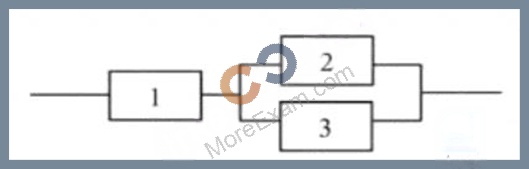
Question81: The following components (1,2,3) each have reliabilities of 0.95.

What is the system reliability?

Question82: When requesting "worst case" design analysis, you expect the reliability group to

Question83: The Malcolm Baldrige framework evaluates an organization's

Question84: The limits of a pre-control chart are based on

Question85: Which of the following tools begins at the point of failure and works back through the process to the components?

Question86: Which of the following assumptions is a robustness factor suitable for validating statistical conclusions?